Field Notes
Mosin-Nagant Rifles

The most frequently asked question we get is how the rifles we use are selected and cleaned for competition. With the increasing interest in the Mosin-Nagant, we thought some shooters might be interested in the field notes we record as we investigate the potential of the available Mosin-Nagant variations. Please remember this is a record of "what we did." It does not even pretend to be a suggestion of what anyone else should do.
We are looking for a Mosin-Nagant that can consistantly produce 10 shot/2" groups at 100 yards. This is Military Bolt Action Rifle competition, so all shooting will be done from a bench rest. Our interest here is the best accuracy these old rifles can deliver. For those who are interested in the collector aspect, we have found another web site that offers good information on the history and variations of the Mosin-Nagant.
This page is under construction. If you find broken links, please report them to our editor.
Rifles
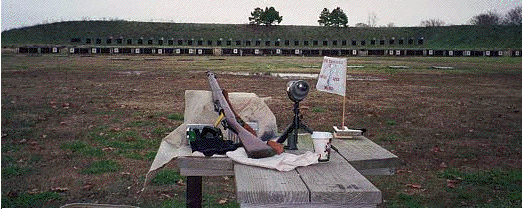
When we select a rifle for competition, we always start with several candidates and compare their initial performance. Given the history of these rifles, their condition--especially the condition of the bores--varies greatly from one rifle to another. For our evaluation of the Mosin-Nagant we started with seven rifles/carbines.

Five of the Mosin-Nagants used for this project. Top to bottom: the Remington 1891, 91/30 (#1), 1938 Carbine, 1939 Sako, and 1944 Carbine.
For the first round of evaluation, the bores were "run out," which means they were cleaned with solvent, wire brush, and patches. The bores--which, when new, ran (about) .300" land to land, and .311" groove to groove--were measured and visually inspected. The reason for the measurement at this point in the process is to determine which sizing die will be needed later on. We determine the size needed by adding the two measurements, dividing by 2, rounding up to the nearest .001, and adding .001. In the case of the 1891 Remington--which is badly shot out--.307 + .317 = .624/2 = .312 + .001 = .313, which means that we must size our bullets to not less than .313" in order to obtain a satisfactory gas seal.
The 1891 Mosin Nagant we used was one of 750,000 rifles produced by Remington here in the United States. The chamber is marked "Remington Armory 1916" and "No. 1595." This is certainly not one of the undelivered rifles which were sold in "new, unissued" condition to the U.S. Government, or to American shooters after the war. Manufactured prior to the 1917 revolution, this rifle was probably delivered to the armies of the Tzar. It may well have seen combat in World War I. Almost certainly it saw action during the revolution on one side or the other--maybe both. It may even have seen some service in world War II. It has been rebuilt--probably several times--and the only Remington parts still remaining are the receiver, the barrel, and the trigger group. This rifle will need repairs to the rear sight before testing. Note in the photograph that it is also missing the cleaning rod. At its smallest point the bore diameter measured .307" land to land, and .317" groove to groove.
The three (3) M'91-'30's came from two different distributers. The crude finish and heavy tool marks are typical of wartime manufacture. They are dated 1942, 1942, and 1943. The parts all match (stamped numbers, not electo-etch). These initally seem to be the most promising of the Nagant's, being in better condition than the 1891, and having a longer sight radius than the shorter carbines. After World War II these rifles were put into long term storage, kept safe against the day when the NATO hordes would pour across the German border to invade Mother Russia. Now that most Russians have figured out NATO isn't coming, these rifles are available in large numbers, at very reasonable prices. Shown in the photograph is the 91/30 we designate #1. It was selected for the photograph because the brass finals on the upper hand guard are properly black. (On 91/30 #2 and #3 the brass finals have been polished[?]) We put a lead slug down the bore of each rifle, with the following results: Rifle #1, .305" across the lands and .314" across the grooves. Rifle #2, .305" across the lands and .314" across the grooves. Rifle #3, .304" across the lands and .319" across the grooves.
The M'38 is marked "1941." It is hard to tell if it is a careful rebuild or original. (The metal finish is MUCH better than the 91-30's, but the wood-to-metal fit can only be described in language not fit for a family web site.) All numbers match. The bore is .305" across the lands and .316" across the grooves.
The Sako M'39 from Finland actually began life as an M1891 from Russia (Tula 1917?) and still sports the "hex" receiver. The barrel is marked with the Sako "'S' in cog," the same SN as the receiver, and the year "1944." The bolt does not match. The bore--which should have once been .3095" across the grooves--measures .305 across the lands and .316 across the grooves.
The M'44 is marked "1944." It is in "very good to excellent" condition, but the bolt does not match. The bore measures .306" across the lands and .314" across the grooves.
Ammunition
A friend donated 200 rounds of 7.62x54R military ammunition, c. 1962. It had a green steel case which can not be reloaded. The spitzer boattail bullet measured .310" dia., weighted 147.8 gr. (nominal 148 gr.) and was marked with a silver tip. The charge was 45.9 gr. of extruded powder. Barnes, Cartridges of the World, reports the MV for this type of military ammunition at 2820 ft./sec.
From a national retailer we purchased 500 rounds of "Brown Bear" 185 gr. FMJ. It uses the same green steel case as the military ammunition, but it is advertised as "boxer primed" and "non-corrosive." When we pulled a cartridge down we found the sptizer boattail bullet actually weighted 186 gr., but this (seriously) was probably due to the thick lacquer coating. The bullet measured 3.11" across the bearing surface (below the lacquer), which may help establish a gas seal in the older (read "shot-out") barrels. The charge was 47.45 gr. of extruded powder, much the same in appearance as the powder from the military round.
From another national retailer we purchased 100 rounds of "Highland" (Prvi Partizan) loaded with a 150 gr. SPBT. This one uses a brass case and is advertised as "boxer primed" and "non-corrosive." The primer is visibly smaller that the steel-case ammo, which raises hopes that we may be able to reload it using American primers. We pulled one down and found the 149.3 gr. soft-point bullet to have a slight boattail. The bullet measured 3.12" at the mid-point of the bearing surface. The charge was 51.5 gr. of the now-familiar extruded powder.
Phase One Data
"Phase One" consists of data obtained firing military surplus and commercial ammunition. At this point the barrels have been "run out" with patches and solvent, but nothing has been done to remove copper fouling or repair pits from years of corrosive ammunition.
We passed over the 1891 as being too worn to yeild useful data, and began with the rifles we identify as M91/30 #1, M38, and the M39. These are very close in bore demensions, and this should tell us how much, if anything, we have to give up in the shorter barrels. Because the primary variable is barrel length, we have arranged our data in that order.
|
Rifle
|
Barrel
|
Military
|
Brn Bear
|
Highland
|
sight r
|
|
91/30
|
28.7"
|
2859
|
2566
|
2818
|
24.5"
|
|
M39
|
27.0"
|
2828
|
2558
|
2817
|
22.5"
|
|
M38
|
20.0"
|
2639
|
2365
|
2618
|
16.5"
|
From these data we find that going from the 24.5" barrel of the M91/30 to the 16.5" barrel of the M 38 means giving up slightly more than 200 f/s of velocity. Going from the M91/30 to the 22.5" barrel of the M39, however, means giving up less than 20 f/s. It will be interesting to see if this relationship holds true when we collect data from the other two M91/30's and the M44.
As an aside, we also saw the disavantage the shorter sight radius of the (M38 and M44) carbines presents to the shootist. The sight r on the 91/30 is 24.5" against the 16.5" sight r on the M38 and M44. This is a ratio of 3:2. This makes the carbines much less tolerant of sight alignment variations than would be the case with the longer M91/30. In theory, sight alignment variations which would produce a 2" group from the M91/30, would produce a 3" group from one of the carbines. In the above tests, we found that the M91/30 produced a 6.5" group at 100 yards, against a 9" group for the M38. It is worth reporting that the M39 produced a 6.5" group, the same as the M91/30. This is certainly worth considering when selecting a rifle for competition. (Yes, the same shootist fired all three groups.)
As we finished collecting data from all seven rifles (see below) we found that the velocities from the M44 were indeed very close to those recorded from the M38. The three 91/30's and the M39 all produced very similar data. The M1891, however, refused to behave itself. The target had to be moved in to 50 yards, and there the groups ranged from 11" to 20 1/2", with most of the bullets going through the target sideways. Average deviations for three (3) ten-shot groups were 82.8, 94.9, and 209.6 ft/sec, with an extreme spread (the "Highland" 150 gr SP) of 547 ft/sec! The largest average deviation for any of the other rifles was 18.9 ft/sec (M91/30 #3 firing the 185 gr "Brown Bear").
The following table shows the initial firing data for all seven rifles.
|
Rifle
|
Barrel
|
Military
|
Brn Bear
|
Highland
|
sight r
|
|
M91
|
31.6"
|
3034
|
2703
|
2983
|
27.0"
|
|
M91/30
|
28.7"
|
2859
|
2566
|
2818
|
24.5"
|
|
M91/30
|
28.7"
|
2842
|
2566
|
2831
|
24.5"
|
|
M91/30
|
28.7"
|
2804
|
2527
|
2800
|
24.5"
|
|
M38
|
20.0"
|
2639
|
2365
|
2618
|
16.5"
|
|
M39
|
27.0"
|
2828
|
2558
|
2817
|
22.5"
|
|
M44
|
20.4"
|
2649
|
2377
|
2636
|
16.5"
|
Bore Preparation
Bore Preparation consists of five operations. First, the barrels are cleaned with brass brushes, copper solvent, and bore solvent, until the patches come out clean. Second, an electrochemical bore cleaner is used to remove copper fouling which may be lodged in pits in the barrel. Third, a bore scope is used to check for pitting which may not be visible from the muzzle or the chamber. Fourth, the bores are fire lapped to reduce the effects of pitting. Fifth, a cast is made of the chamber which allows exact measurement of the chamber dimensions and the precise evaluation of the headspace situation.
CLEANING: We are convinced that these rifles were not properly cleaned before they were placed in storage. (This is why we purchase solvent in 32 oz. bottles and patches in bags of 1,000.) After the initial 30-round testing, M91/30 rifle #1 and #3 each took four hours (or longer) just to get it clean enough to hook up the electrochemical bore cleaner. As a control, we took 91/30 #2 which we had not yet fired, and began to clean the bore throughly. (This rifle was advertised by the importer as "In Excellent to New Condition.") Once the grease was removed, we cleaned the bore with mineral spirits and ran a new brass brush down the barrel. We followed that with a wet patch. The patch came out absolutely black! More patches produced black carbon mixed with tiny flakes of metal.
Unlike the 91/30's, the M38 cleaned up easily, showing little more than the fouling from the 30 test rounds. The M44 was very much the same. We thought the M39 was easy to clean too, but once we hooked it up to the electrochemical bore cleaner (EBC), we quickly discovered it was not clean at all. It required several additional hours of work to get it ready for a second session on the EBC.
The M1891 seemed to clean easily, but we noticed that the cleaning rod did not rotate as it went up and down the bore. We have encountered this before in rifles when the jag is too small, and at this point we attributed it to the use of a .30 cal. jag in a badly worn .310 bore. Here we repeated the mistake we had made with the M39 and put the 1891 on the EBC.
ELECTROCHEMICAL BORE CLEANING: The first rifle on the electrochemical bore cleaner (EBC) was the M39. At end of the first hour the cleaning solution had turned to orange jelly. (This indicates the presence of rust.) The bore was again cleaned with mineral spirits and filled with fresh solution, but after four hours it still did not register as "clean."
The second rifle was 91/30 #1. It registered "clean" after less than an hour and a half.
Next on the EBC was the M38. The "clean" light came on after only 15 minutes!
After several hours of copper solvent and patches, the M39 was put back on the EBC. This time the light flashed "cleaning" and then went directly to "clean."
The next rifles were 91/30 #3 and #2. Again, the "cleaning" light only flashed on, and was followed by the "clean" indication.
The M38 and M44 were both pretty much the same story. It took some effort to clean the bores, but when placed on the EBC the light only flashed "cleaning" and then went to "clean."
The 1891 was nothing short of a nightmare. After hours of cleaning, patches were finally coming out clean. It was degreased and hooked up to the EBC. In less than an hour, the electrolite had turned to three-day-old coffee and the rod was coated with a thick, black, tar-like substance. Back in the cleaning vise, solvent-wet patches came out black with the same material. Once that was removed--some 100 patches later--patches wet with copper solvent began to come out dark green.
BORE SCOPE: Each rifle was inspected and graded on a scale of one to five as follows:
- Grade One: Bore may be dark, but without pitting
- Grade Two: Some light pitting, commensurate with use of corrosive ammunition
- Grade Three: Moderate pitting, sufficient to effect velocity and accuracy
- Grade Four: Heavy pitting, sufficient to prevent an adequate gas seal
- Grade Five: You actually shot this thing?
The bore scope showed the 1891's bore to be even worse than expected. From the chamber, there is 3" of heavy pitting. Afer that the rifling is completely gone for about 6", and the bottom of the bore has a "belly" cut into it by corrosion. In one place the bore is actually elliptical in cross section. This rifle has less than six inches of visible rifling. Overall condition: Grade Five.
M91/30 #1 has an undamaged crown and showed excellent rifling near the muzzle. Working from the muzzle to the chamber, we began to encounter light pitting about 15" back. Nearing the chamber, extensive erosion could be seen on the driving edge of the lands. The throat is very short--about 3/16". Overall condition: Grade Two.
M91/30 #2 shows no erosion or pitting of any significance. Very light pitting in front of the chamber should come out with fire lapping. The throat is very short--less than 1/8". The rifling is strong and clean at the breech. Near the muzzle there is some slight wear from cleaning and the use of jacketed bullets. JP, who does the bore scope evaluations, feels this is the best bore of the lot. Overall condition: Grade One.
M91/30 #3 near the muzzle showed no pitting to speak of. Working toward the chamber, the lands showed erosion indicating heavy use. There was considerable erosion for about 1/2" in front of the throat, the throat itself being an additional 1/2" in length. Overall condition: Grade One.
The M38 is freebored for about 1 1/2" at the muzzle. From there moderate pitting became light as the scope neared the chamber. The throat is about 1/2" with severe erosion for about 1 1/2" beyond that. The entire barrel showed extensive erosion on the driving edge of the lands, the leading edge being worn down to about 66% of the trailing edge. Overall condition: Grade Two.
The M39 is freebored for 1/2" at the crown. The next four inches showed minimal corrosion. From there to within 2" of the chamber, the rifling is crisp and clean, with little evidence of erosion. The throat is short--only about 1/4"--but the 2" in front of the throat shows minor corrosion. Overall condition: Grade One.
The M44 has a strong crown recessed a full inch, with 1 and 3/16" of freebore. The throat in front of the chamber is 3/4". There is still evidence of finish in the grooves, which will need to be polished out to obtain the best accuracy. Overall condidtion: Grade One.
FIRE LAPPING: At this point we pull three rifles for additional consideration. (The 1891 is a historic relic. Nothing we can do is going to put the metal back in the bore.) One 91/30 is enough for our project, and we have selected 91/30 #2. We also want to keep working with the M39 and one of the carbines. Because the M44 has the better bore, we will use it for the rest of these tests.
For the fire lapping we select Hornady 165 gr. Spire Point .308 dia. bullets. These bullets have a BC of only 0.387, but the flat base gives us more than .3 sq/in of bearing surface for the abrasive compound. Because of the additional friction from the abrasive compound, we want to keep the powder charge low in order to reduce internal pressure. For IMR 4895, our manual for the 7.62x54R lists 2300 f/s from 38.3 gr., so we will start with 34.4 gr. just to be safe.
Let the record show that something more than two months has passed since the paragraph above. Fire lapping with .308 dia. bullets does nothing but make the lands nice and shiny. We go to .311 jacketed bullets. Those aren't much better. Finally we dig out a mold for cast bullets with a nonimal dia. of .311 and a measured (when cast) dia. of .312. We use soft lead and seat the gas check seal in a .314 sizing die. We use a starting load of 12 gr. Unique, which is enough to get the bullets down the bore reliably.

Five of the ugliest cartridges we have ever loaded. In order to clear the neck of the chamber, the bullets could only be seated to the bottom of the first band.
The resizing took the necks of the cases down to .308, so a universal die was used to expand the case mouths. When the .314 cast bullets were seated to the usual depth, it was found that the chambers of the rifles would no longer admit the necks of the cases. This was solved by seating the cast bullets only to the base of the first band. This produced some very unattractive cartridges, but they accomplished the fire lapping without any further difficulty.
Phase Two Data
Now that we have our three "semi-finalists" cleaned up and the worst of the worst polished out of the bores, we want to see how they do with the same production ammunition we used in Phase One. This time we are going to report ten-shot groups rather than velocity. (Once an old military barrel has been properly cleaned, the MV tends to drop slightly. We believe this is because the clean bore allows more blow by.)
|
Rifle
|
Barrel
|
Military
|
Brn Bear
|
Highland
|
sight r
|
|
91/30
|
28.7"
|
9.533"
|
7.497"
|
TBA
|
24.5"
|
|
M39
|
27.0"
|
4.484"
|
4.916"
|
5.290"
|
22.5"
|
|
M44
|
20.0"
|
TBA
|
TBA
|
TBA
|
16.5"
|
Loading
To avoid disappointment, we warn you up front that this is not loading data. (A good place to start with loading data is the web page of Karl Leffier.) We are going to deal with bullet weight, design (ballistic coefficient), and velocity. How a specific velocity can be obtained is too much a function of the individual rifle to be explored here.
We are divided in our opinions of how to proceed. One way would be to try to build our ammunition around readily available .308 commercial bullets. Another way would be to build around commercial .311 (.303 British/7.7 Jap) bullets. Finally, one of us (who has some considerable experience with 7.62x54R) is convinced nothing but cast bullets has any real accuracy potential.
We had earlier made a phone call to the nice folks at Sierra Bullets. The Sierra load data for the 7.62x54R uses .308 bullets, but we learned that their test rifle was a 1891 [American made] Westinghouse in excellent condition. The "bulletsmith" at Sierra was doubtful that we could obtain respectable accuracy with ANY bullet, given the poor condition of our barrels.
Phase Three Data
Phase Three Data is under construction.
Frequently Asked Questions
These "Frequently Asked Questions" are from our Email.
QUESTION: I read in Shotgun News that Mosin-Nagants will shoot two inch groups in "as Issued" condition. Is this true?
RESPONSE: This question seems to refer to "Those Wonderful Mosins" by David M. Fortier. It appeared in Vol. 62, Issue 17 (June 10, 2008) of Shotgun News, p. 14-19. It is a good article and well worth reading. We agree with much of what Mr. Fortier writes, especially about the problem with the short sight radius on the M38 and M44 carbines. His velocity data differs from ours, probably because he reports collecting his data at an ambient temperature of 55 degrees F, where our testing is done between 89 and 92 degrees F. As to Mr. Fortier's report of five-shot groups under 2" at 100 yards, we can only observe that his experience has not been our experience.
"The worst day on the range is still better than the best day at the office." Joe Charles
Return to Club Home Page